IlfordHP5 Plus
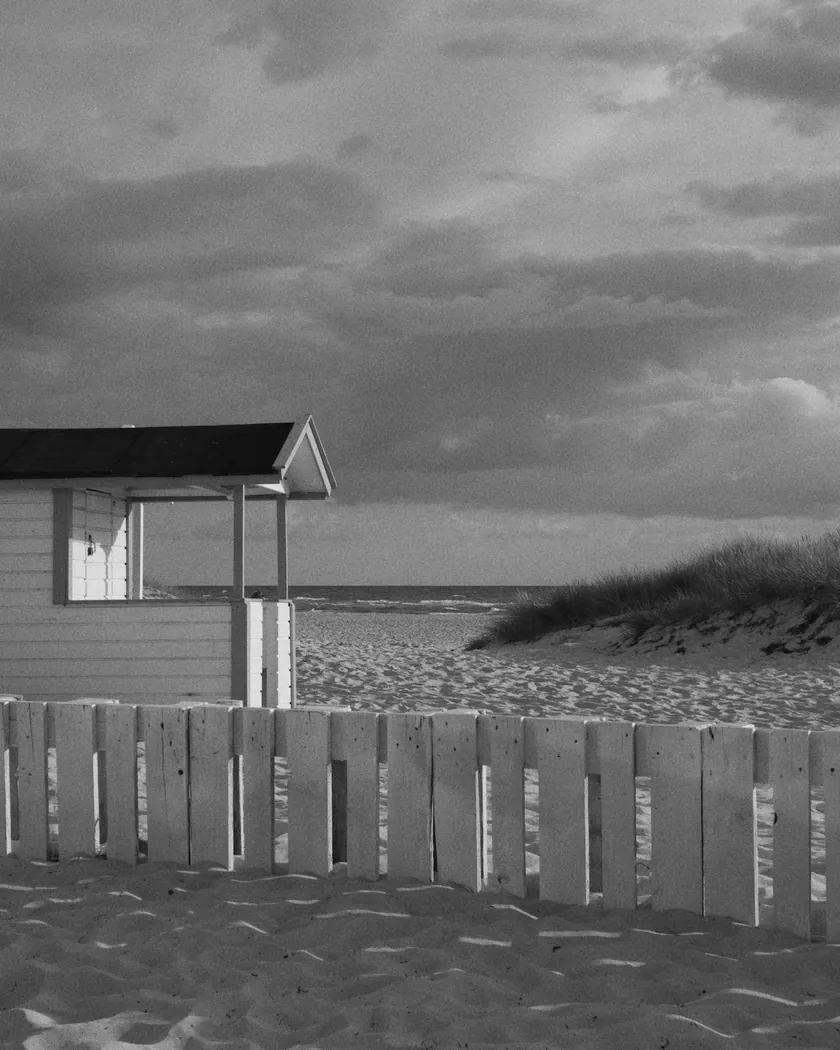
Subtle tones and visible grain; skies lighter than the eye sees them
- Manufacturer
- Harman technology
- ISO
- 400
- Type
- Black and white
- Process
- B&W
- Formats
- 135, 120, 4x5, 5x7, 8x10
- Status
- In production
- Datasheet
- HP5 Plus Technical Information
- Preset
- GA — 001 / P
Status checked [2]

Character
- Contrast
- Medium (Ilford); reviews range from low to high
- Grain
- No RMS figure published; reviews disagree on Tri-X vs HP5
- Latitude
- EI 400 to 3200 with adjusted development (Harman)
- Best for
- Action, documentary and available light (Ilford)
Ilford HP5 Plus is an ISO 400 panchromatic black-and-white negative film, made in England by Harman technology under the Ilford Photo brand. Harman sells it for action, available light and general photography, and rates it for good prints up to EI 3200 with extended development [1]. It has carried the HP5 Plus name since 1989 and is the usual counterpart to Kodak Tri-X [3] [4].
Look and color
HP5 Plus turns colors into grays according to its own spectral sensitivity, not the eye’s:
- More weight on blue. Harman’s spectrogram is measured under tungsten light. Once that light is compensated for, blue weighs more than on Tri-X: in the weights computed from the two datasheets, the Z weight, which carries most of the blue, is 0.49 for HP5 Plus against 0.39 for Tri-X [1] [17]. darktable’s built-in “monochrome | ILFORD HP5+” preset is built from the same datasheet [14].
- Measured on our test RAW files. With those weights instead of plain luminance, a sky came out 4.1 L* lighter, skin 5.7 L* darker and a pink shirt 2.6 L* darker; the same conversion with the Tri-X curve moved them by +3.2, −3.8 and −1.2 [17].
- No review describes how HP5 Plus renders skies, skin or reds, so this section relies on the datasheet.
- Tones. The Darkroom speaks of “beautifully subtle tones, medium to low contrast” [8]. For Emulsive, much of the range is “bunched up in those lovely mid-tones, although highlights and deep blacks are represented very well” [5].
Tonality
- Curve. Harman publishes one characteristic curve, for Ilfotec HC 1+31, 6½ minutes at 20 °C. Base plus fog sits near 0.18; the toe spans about one log unit; the straight section has a slope of about 0.64, with no shoulder up to a density of 2.1 (our reading of the graph) [1]. The Tri-X curves are for other developers, so the two datasheets alone do not say which film is more contrasty.
- Contrast: medium, with dissenters. Ilford calls it “medium contrast” [2], and Emulsive gets “a medium contrast result” at box speed [5]. Next to Tri-X it looks “a little flatter” [10] or “more nuanced and balanced” [11]. The Darkroom credits it with “strong tonality without crushing blacks” [9]. Casual Photophile, on the other hand, writes of its “characteristic high contrast” [7].
- Where the contrast sits. Reading the published curves, 35mmc’s Aukje concluded that “Tri-X will display more contrast in the highlights, where HP5+ will give more contrast in the shadows” [12].
- Shadows: the sources disagree.
- More detail than Tri-X: “its shadows retain more detail than many comparable films (including Tri-X)” [6]; “the winner again for the details in the shadows” [10].
- Less: HP5 Plus “retains less shadow detail than other films in its segment” [7]; “some fall-off in shadow detail in especially dark scenes” [5].
- Highlights: “least likely to get washed out by over-exposure” [6].
- Latitude. Harman gives good results from EI 400 to 3200 and notes that this range comes from practical evaluation, not the ISO method [1]. Reviews praise its latitude [5] [8] [11]; from the curve, Analog.cafe estimates about 12 stops [6]. The Darkroom notes that it is “easily pushed to 800 or 1600 for added contrast” [8].
- Long exposures: no correction from 1/10,000 to ½ s; beyond, Harman’s formula gives adjusted time = metered time^1.31 [1].
Grain and sharpness
| Film | Diffuse RMS granularity | Developer |
|---|---|---|
| Ilford HP5 Plus | not published [1] | – |
| Kodak T-Max 400 | 10 [16] | D-76 |
| Kodak Tri-X 400 | 17 [15] | HC-110 (B) |
- Harman publishes no granularity, resolving power or MTF figure for HP5 Plus [1], as reviewers have noted [12].
- Reviews disagree on HP5 Plus against Tri-X:
- Casual Photophile finds the grain “certainly present” but not in the way of sharpness [7].
Spectral sensitivity
Under 2850 K tungsten light, sensitivity rises from about 352 nm to a broad plateau between 445 and 480 nm, dips slightly around 500 nm, peaks around 570 to 580 nm, shows a small bump near 625 nm, then falls steeply from 630 nm to the baseline near 658 nm [1]. Corrected for that light, the curve gives more weight to blue than Tri-X: skies turn lighter, skin and reds darker than in a luminance conversion [17].
Datasheet digest
| Item | Value | Source |
|---|---|---|
| ISO speed | 400; good results from EI 400 to 3200 with extended development (a practical rating, not an ISO speed) | [1] |
| Granularity | Not published | [1] |
| Characteristic curve | Toe of about 1 log unit, straight section with a slope of about 0.64, no shoulder up to a density of 2.1 (Ilfotec HC 1+31, 6½ min; read from the graph) | [1] |
| Base plus fog | About 0.18 (read from the graph) | [1] |
| Reciprocity | No correction from 1/10,000 to ½ s; beyond, adjusted time = metered time^1.31 | [1] |
| Kodak D-76 stock, 20 °C | 7½ min at EI 400, 9½ at 800, 12½ at 1600 | [1] |
| Ilfotec DD-X 1+4, 20 °C | 9 min at EI 400, 13 at 1600, 20 at 3200 | [1] |
| Spectral data | Wedge spectrogram under 2850 K tungsten light | [1] |
| Bases | 35 mm: 0.125 mm acetate; 120: 0.110 mm acetate; sheets: 0.180 mm polyester | [1] |
| Resolving power | Not given; no MTF curve published | [1] |
Names, status and history
- 1931 to 1989. HP began as Hypersensitive Panchromatic plates in 1931 and was sold as HP film from 1935 [4]. HP5 was launched in 1976, and HP5 Plus introduced in 1989 [3].
- Harman. Since a 2005 management buyout, the film is made by Harman technology, which trades as Ilford Photo at Mobberley, Cheshire [3].
- Formats. The datasheet lists 35 mm in 24 and 36 exposures and 30.5 m (100 ft) bulk, 120 roll film and sheet film, and DX-coded cassettes [1]. On September 29, 2026, Ilford listed 35 mm, bulk, 120 and sheet film [2].
- Push. Ilford’s product page says it “can be rated up to El 3200/36°” (sic) [2].
- Datasheet. The current edition dates from November 2018 [1].
Alternatives
- GA — 003 Kodak Tri-X 400
The other classic ISO 400: more contrast in side-by-side tests, and a published RMS of 17
- GA — 019 Kodak T-Max 400
Kodak's tabular-grain ISO 400: finer grain on paper (RMS 10) and, per Kodak, less blue sensitivity
- GA — 020 Ilford FP4 Plus
Harman's slower classic black-and-white film, at ISO 125
Get the look in darktable
The GA — 001 / P preset, inspired by Ilford HP5 Plus, is a darktable 5.6 style of 4 native modules, with no LUT. It sits on top of your own exposure and tone mapping.
| Zone | Metric | Before → after |
|---|---|---|
| sky | L (channel weights only) | 55.2 → 59.3 |
| skin | L (channel weights only) | 79.3 → 73.6 |
| pink T-shirt | L (channel weights only) | 47.8 → 45.2 |
Settings, all measurements and limits of the Ilford HP5 Plus preset
GA — 001 / P · darktable preset
HP5 Plus
for darktable
See real photos
Scans of real Ilford HP5 Plus film, published by others:
Questions about Ilford HP5 Plus
Can you push HP5 to 3200?
Yes. Harman rates HP5 Plus for good image quality from EI 400 up to EI 3200 with extended development: for EI 3200, 20 minutes in Ilfotec DD-X 1+4 or 16 in Microphen, at 20 °C. Harman notes that this range comes from practical evaluation, not from the ISO standard.
Is HP5 C-41?
No. HP5 Plus is a traditional black-and-white film, developed in black-and-white developers such as Ilfotec DD-X, ID-11, Kodak D-76 or HC-110; Harman's datasheet gives no C-41 times. It needs a lab or a home setup that develops black-and-white film, not a color line.
Is HP5 panchromatic?
Yes. Harman's wedge spectrogram shows sensitivity from the near ultraviolet to about 655 nm, falling steeply above 630 nm. Compared with the eye, HP5 Plus gives relatively more weight to blue, so on our test images skies came out lighter, and skin and reds darker, than in a plain luminance conversion.
HP5 Plus vs Tri-X?
Both are classic ISO 400 films. Comparisons find HP5 Plus flatter, with more balanced contrast and, for most reviewers, more shadow detail; Casual Photophile disagrees on the shadows. Grain is disputed: some find Tri-X grittier, others HP5 Plus. Kodak publishes an RMS of 17 for Tri-X; Ilford publishes no figure.
Is HP5 DX coded?
Yes. Harman supplies HP5 Plus 35 mm film in DX-coded cassettes of 24 or 36 exposures, so cameras that read DX codes set ISO 400 automatically. To shoot it at another exposure index, such as EI 1600 for push processing, set the speed by hand and tell the lab.
Sources
- 1DS Ilford HP5 Plus, technical information (Harman technology, November 2018)
- 2M Ilford Photo: HP5 Plus 35mm, product page Accessed September 29, 2026.
- 3M Ilford Photo: History Accessed September 29, 2026.
- 4C Wikipedia: Ilford HP Accessed September 29, 2026.
- 5C Emulsive: Film review, Ilford HP5 Plus in 35mm, 120 and sheet formats (EM, November 23, 2017) Accessed September 29, 2026.
- 6C Analog.cafe: Ilford HP5+ film review (Dmitri, updated December 14, 2025) Accessed September 29, 2026.
- 7C Casual Photophile: Ilford HP5 Plus, black and white film profile (Josh Solomon, November 18, 2016) Accessed September 29, 2026.
- 8C The Darkroom: Ilford HP5 Plus 400 film review Accessed September 29, 2026.
- 9C The Darkroom: Kodak Tri-X vs. Ilford HP5 (March 1, 2021) Accessed September 29, 2026.
- 10C Shoot It With Film: Kodak Tri-X, Ilford HP5 and Kodak T-Max comparisons (Amy Elizabeth, January 31, 2020) Accessed September 29, 2026.
- 11C Analogue Wonderland: The eternal debate, Kodak Tri-X vs. Ilford HP5 Plus (Paul McKay, updated March 8, 2024) Accessed September 29, 2026.
- 12C 35mmc: Ilford HP5 vs Kodak Tri-X, finding my go-to black and white film (Aukje, May 13, 2016) Accessed September 29, 2026.
- 13C 35mmc: Kodak Tri-X 400 or Ilford HP5+ 400, who? when? where? (Giacomo Cecot, November 6, 2025) Accessed September 29, 2026.
- 14C darktable source code: color calibration presets (src/iop/channelmixerrgb.c) Accessed September 29, 2026.
- 15DS Kodak Professional Tri-X 320 and 400, technical data F-4017 (October 2021)
- 16DS Kodak Professional T-Max 400, technical data F-4043 (February 2016)
- 17B The Grain Archive: Ilford HP5 Plus style, validation measurements
DS: datasheet · M: manufacturer · C: review or community · B: Grain Archive measurement