FujifilmVelvia 50
Extremely saturated, deep blues, a leaning toward magenta and purple
- Manufacturer
- Fujifilm
- ISO
- 50
- Type
- Slide
- Process
- E-6
- Formats
- 135, 120
- Status
- In production
- Datasheet
- AF3-0221E2
- Preset
- GA — 014 / P
Status checked [2]
Character
- Contrast
- High; the curve steepens toward the shadows (datasheet)
- Grain
- Diffuse RMS granularity 9 (datasheet)
- Latitude
- Narrow: about 5 stops of usable range
- Best for
- Nature, fashion, products, interiors and artwork (Fujifilm)
Fujifilm Velvia 50 (Fujichrome Velvia 50 Professional, code RVP50) is an ISO 50 daylight color slide film for E-6 processing, sold by Fujifilm on “the world’s highest level of image color saturation” [1]. It replaced the original Velvia of 1990, discontinued in 2005, and Fujifilm describes it as “nearly identical in performance” [1] [4]. It is still in production in 35 mm and 120 [2].
Look and color
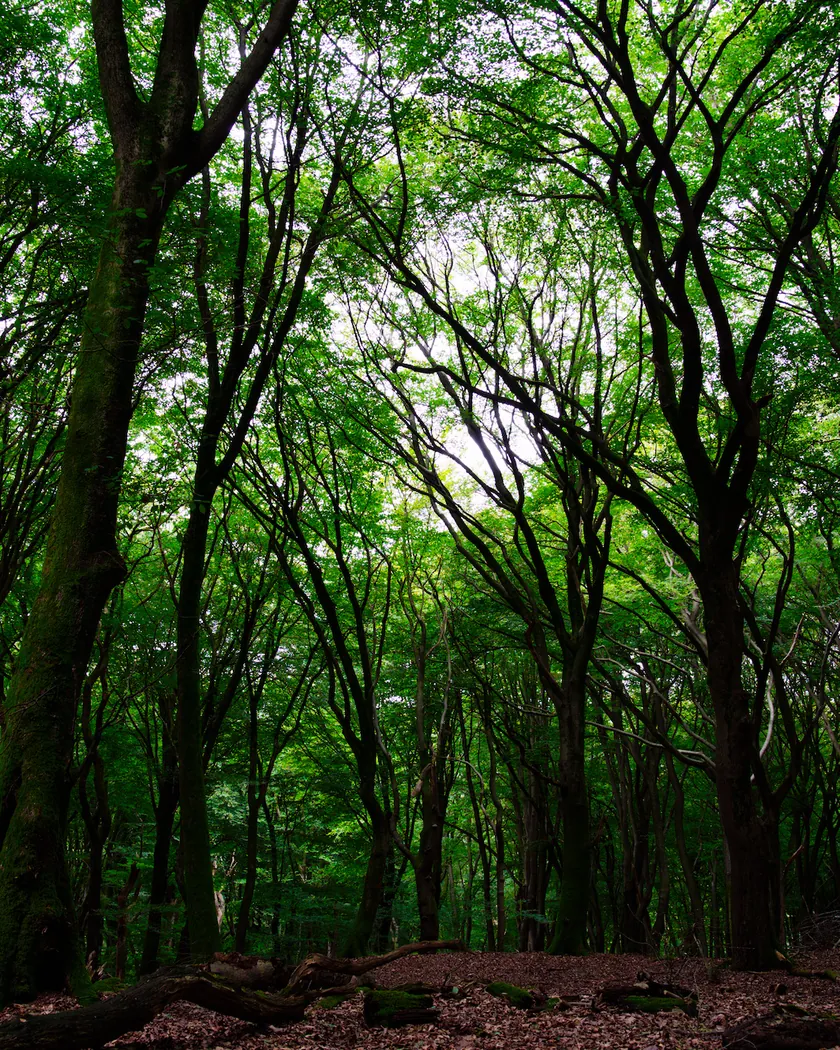
- Saturation is the point. Fujifilm promises the highest color saturation and vibrancy [1]. Reviews speak of “strongly saturated” colors with “starker blues and reds” [5], and of results “very very saturated, which is an acquired taste” [11]. Analog.cafe finds today’s Velvia 50 “milder” than the original [5].
- Magenta and purple. A 35mmc author likes “the famous (or notorious, depending on your taste) magenta cast of Velvia”, and an “indigo hue” in blues [8]. In a side-by-side with Ektachrome E100, Velvia “consistently enhanced or added purple and pinkish hues, even when they weren’t there” [7].
- Warm next to E100. The same test found E100 “too cold”, and Velvia more saturated in yellows, oranges and purples, E100 in pinks and some reds [7]. Alex Burke notes that Velvia “tends to shift to the warm hues” and rarely needs a warming filter [9].
- Greens. “Impressive colour saturation, particularly with greens” [8].
- Soft light. Burke finds it “great at bringing out the vibrant detail” in open shade and overcast scenes [9].
- Skin: the manufacturer and the reviews disagree. Fujifilm promises “vivid skin tone reproduction” [1]. Reviews warn that portraits “often look unflattering due to a red tint on skin tones” [11], and a reviewer praises Provia for skin that does not look like “boiled prawns”, where Velvia 50 would not suit [12].
Tonality
- Curve. On the datasheet, D-min is about 0.13 and D-max about 3.35 (red) to 3.8 (green). The slope is about 1.2 in the highlights and 1.6 in the midtones, then steepens to 2.5 or 3 in the shadows before an abrupt shoulder: shadows block up quickly. About 5 stops separate densities 0.3 and 3.0 [1] (our reading of the graph).
- A narrow latitude. “About 5 stops of dynamic range” [5]; “very limited exposure latitude” [6]; “not much room for error” [9].
- Which way to err: the sources disagree.
- Analog.cafe advises erring toward underexposure, because overexposed spots “quickly turn pure white” [5].
- Emulsive’s Roger Harrison advises the opposite, as overexposed frames are easier to recover [6], and a customer review suggests 1/3 to 2/3 stop more in contrasty light to keep the shadows [11].
- With the original Velvia, many photographers used EI 40 or 32 for less saturation and more shadow detail [4].
- Contrasty scenes lose shadow or highlight detail [8]. The Darkroom finds Velvia 50 better than Velvia 100 in contrasty light, with smoother tonal transitions [10].
- Processing: push or pull from −1/2 to +1 stop with minimal color change [1].
- Long exposures need magenta filtration from 4 s, and Fujifilm does not recommend 64 s [1]. Burke adds that colors get more saturated as exposures lengthen [9].
Grain and sharpness
| Film | Diffuse RMS granularity | Resolving power (1000:1) |
|---|---|---|
| Fujifilm Velvia 50 | 9 [1] | 160 lines/mm [1] |
| Fujifilm Velvia 100 | 8 [16] | – |
| Fujifilm Provia 100F | 8 [13] | 140 lines/mm [13] |
| Kodak Ektachrome E100 | 8 [15] | not given [15] |
| Fujifilm Astia 100F (discontinued) | 7 [14] | 140 lines/mm [14] |
- All are read at a density of 1.0 with a 48 µm aperture, but Fujifilm’s Velvia and Provia sheets measure 1.0 above D-min, while Kodak and the Astia sheet use a gross density of 1.0: close, not identical, conditions [1] [13] [14] [15].
- Grain: a contradiction. Analog.cafe calls Velvia “the finest-grained colour film in production” [5], yet its published RMS of 9 is coarser on paper than Provia 100F’s or E100’s 8.
- Sharpness. Velvia 50’s 160 lines/mm at high contrast is the highest figure in this table [1]; Wikipedia calls it the highest resolving power of any slide film [4].
Spectral sensitivity
All three layers top out at about the same height. Blue is nearly flat from about 410 to 455 nm, green peaks near 549 nm with a small second hump near 575 nm, and red peaks near 650 nm [1]. Neighboring layers overlap only low down: measured from the green peak, the blue–green and green–red crossings sit about 1.15 and 0.9 log lower, against about 0.95 and 0.75 on Provia 100F and 0.9 and 0.75 on Astia 100F [1] [13] [14] (our reading of the three datasheets). On paper, Velvia’s green layer is the most isolated of the three; the Grain Archive style is not computed from these curves.
Datasheet digest
| Item | Value | Source |
|---|---|---|
| ISO speed | 50 in daylight; 16 under 3200 K tungsten with a Wratten 80A filter | [1] |
| Diffuse RMS granularity | 9 (48 µm aperture, density 1.0 above D-min) | [1] |
| Resolving power | 80 lines/mm at 1.6:1 chart contrast, 160 lines/mm at 1000:1 | [1] |
| Characteristic curve | D-min about 0.13, D-max about 3.35 (red) to 3.8 (green); slope about 1.2 in the highlights, 1.6 in the midtones, 2.5 to 3 in the shadows, then an abrupt shoulder; about 5 stops from D 0.3 to 3.0 (our reading of the graph) | [1] |
| Push and pull | Minimal color balance change from −1/2 to +1 stop | [1] |
| Reciprocity | No correction from 1/4000 to 1 s; 5M and +1/3 stop at 4 s, up to 12.5M and +1 stop at 32 s; 64 s not recommended | [1] |
| Base | Cellulose triacetate, 127 µm (135) and 98 µm (120, 220); polyester, 175 µm (sheets) | [1] |
| Process | E-6 or Fujifilm CR-56 | [1] |
Names, status and history
- 1990–2005: the original Velvia (RVP). An ISO 50 film known for its saturation, discontinued in 2005 because of difficulties in obtaining some raw materials [4].
- 2005: Velvia 100 was introduced to replace it [4].
- 2007: Velvia 50 (RVP50). Fujifilm brought an ISO 50 Velvia back, made with new production technologies and substitutes for raw materials that had become hard to procure, “nearly identical in performance” to the original [1] [4].
- 2021: end of sheet film. In October 2021, Fujifilm announced the end of Velvia 50 in 4×5 and 8×10, expected in December 2021 for 8×10 and March 2023 for 4×5, again because of raw material procurement [3]. The 220 format and QuickLoad sheets are also gone [4].
- Velvia 100 in the US. Fujifilm stopped selling Velvia 100 in the US on July 6, 2021 [16].
- In production. On September 29, 2026, Fujifilm’s US site listed Velvia 50 in 35 mm and 120 [2].
Alternatives
- GA — 015 Fujifilm Provia 100F
Fujifilm's other slide film in production: one stop faster, RMS 8, less saturated and less contrasty
- GA — 017 Kodak Ektachrome E100
The other ISO 100 slide film in production, RMS 8; cooler, with less saturated yellows and oranges in one side-by-side
- GA — 038 Fujifilm Velvia 100
One stop faster, RMS 8, designed for more accurate color at a similar saturation; not sold in the US since July 2021
- GA — 007 Kodak Ektar 100
A color negative sold on high saturation, for landscapes where a slide film's narrow latitude is a problem
Get the look in darktable
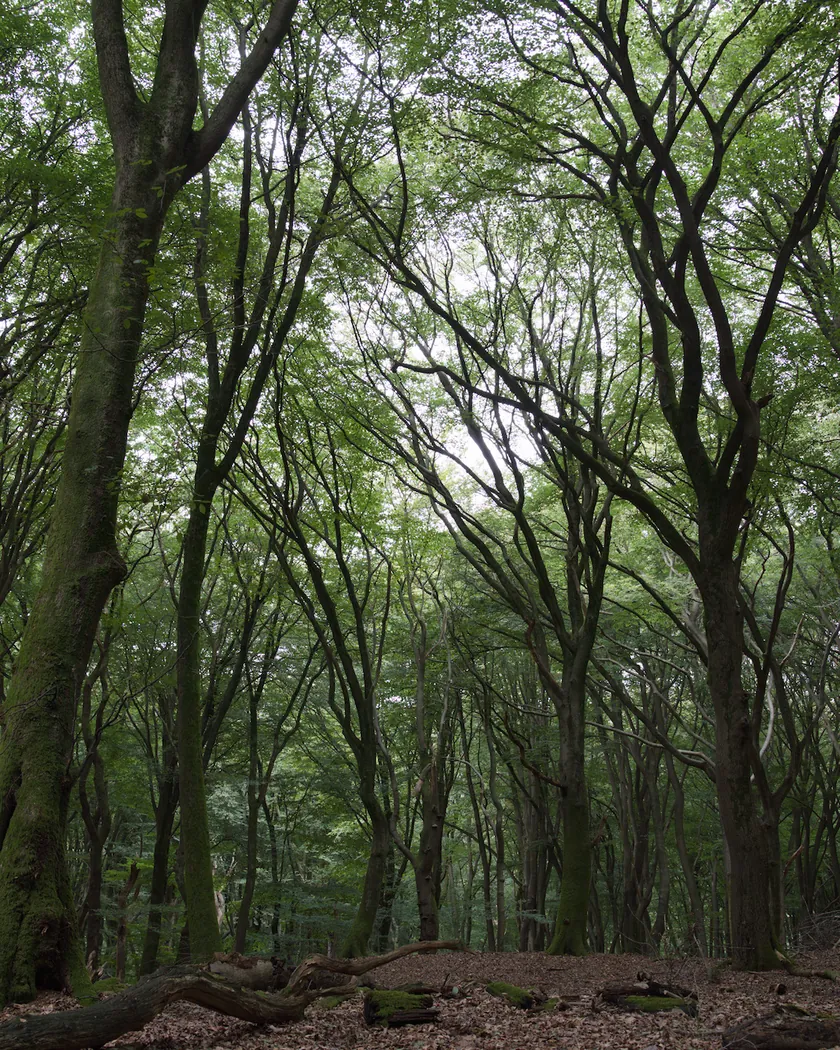
The GA — 014 / P preset, inspired by Fujifilm Velvia 50, is a darktable 5.6 style of 4 native modules, with no LUT. It sits on top of your own exposure and tone mapping.
| Zone | Metric | Before → after |
|---|---|---|
| sky | C (chroma) | 27.5 → 43.3 |
| sea | C (chroma) | 22.2 → 40.1 |
| skin | h (hue, °) | 44.2 → 39.9 |
Settings, all measurements and limits of the Fujifilm Velvia 50 preset
GA — 014 / P · darktable preset
Velvia 50
for darktable
See real photos
Scans of real Fujifilm Velvia 50 film, published by others:
Questions about Fujifilm Velvia 50
Is Velvia 50 discontinued?
No. On September 29, 2026, Fujifilm's US site listed Velvia 50 in 35 mm and 120. Only the sheet sizes were dropped: Fujifilm announced in October 2021 that 8×10 would end that year and 4×5 by March 2023, because of raw material shortages. The original Velvia ended in 2005; Velvia 50 replaced it in 2007.
Velvia 50 vs Velvia 100?
Velvia 100, introduced in 2005, is one stop faster with finer grain on paper (RMS 8 against 9), and was designed for more accurate color at a similar saturation. The Darkroom finds that Velvia 50 handles contrasty light better, with smoother tonal transitions. Velvia 100 has not been sold in the US since July 2021.
Velvia 50 vs Provia 100F?
Provia 100F is one stop faster, slightly finer (RMS 8 against 9) and less saturated and contrasty, with 'a little more realistic' colors for one reviewer. It also handles long exposures better: no correction up to 128 seconds, against 1 second for Velvia 50. Velvia resolves more on paper: 160 lines/mm against 140.
What is the reciprocity failure of Velvia 50?
Fujifilm requires no correction from 1/4000 to 1 second. From 4 seconds, it recommends magenta filtration and more exposure: 5M and +1/3 stop at 4 s, 7.5M and +1/2 at 8 s, 10M and +2/3 at 16 s, 12.5M and +1 stop at 32 s. It does not recommend exposures of 64 seconds.
Is Velvia 50 good for portraits?
Usually not. Fujifilm promises 'vivid skin tone reproduction', but reviews warn that portraits 'often look unflattering due to a red tint on skin tones', and one reviewer contrasts Provia's skin with Velvia's. Fujifilm made Astia 100F, now discontinued, for skin tones; Provia 100F is its neutral slide film.
Sources
- 1DS Fujifilm Fujichrome Velvia 50 Professional [RVP50], product information bulletin AF3-0221E2 (print code KAMIQ-07.3), copy hosted by ishootfujifilm.com
- 2M Fujifilm USA: Fujichrome Velvia 50, product page Accessed September 29, 2026.
- 3C Emulsive: Discontinuation notice, Fujichrome Velvia 50 in 4×5 and 8×10 (October 15, 2021) Accessed September 29, 2026.
- 4C Wikipedia: Velvia Accessed September 29, 2026.
- 5C Analog.cafe: Fujifilm Fujichrome Velvia 50 film review (updated April 11, 2025) Accessed September 29, 2026.
- 6C Emulsive: Effectively shooting Fuji Velvia 50 and other slide films (Roger Harrison, February 10, 2017) Accessed September 29, 2026.
- 7C Emulsive: A comparative test of Kodak Ektachrome E100 and Fujifilm Velvia 50 (Kathleen Johnson, updated July 31, 2021) Accessed September 29, 2026.
- 8C 35mmc: Fujifilm Velvia and my shallow and shameless dumping of Kodachrome (Simon Foale, September 4, 2023) Accessed September 29, 2026.
- 9C Alex Burke: Color film choices for landscapes (updated April 20, 2023) Accessed September 29, 2026.
- 10C The Darkroom: Velvia 50 film review Accessed September 29, 2026.
- 11C Analogue Wonderland: Fujifilm Velvia 50, 35mm, product page and customer reviews Accessed September 29, 2026.
- 12C Richard Haw: Review, Fujifilm Provia 100 (December 2, 2020) Accessed September 29, 2026.
- 13DS Fujifilm Fujichrome Provia 100F Professional [RDP III], data sheet AF3-036E
- 14DS Fujifilm Fujichrome Astia 100F Professional [RAP100F], product information bulletin AF3-149E, copy hosted by 125px
- 15DS Kodak Professional Ektachrome E100, technical data E-4000 (August 2018)
- 16M Fujifilm USA: Fujichrome Velvia 100, product page Accessed September 29, 2026.
DS: datasheet · M: manufacturer · C: review or community