IlfordDelta 3200 Professional
Grain everywhere, shadows that block up at EI 3200, highlights that hold
- Manufacturer
- Harman Technology
- ISO
- 1000
- Type
- Black and white
- Process
- B&W
- Formats
- 135, 120
- Status
- In production
- Preset
- GA — 022 / P
Status checked [4]
Character
- Contrast
- Reviews disagree, from 'low' to 'hard blacks'; rises with development time
- Grain
- No RMS published; heavy but 'oddly smooth' according to reviews
- Latitude
- ISO 1000; EI 400 to 6400 at good quality, up to EI 25000 after tests (Ilford)
- Best for
- Action and available light: night, concerts, sport, interiors (Ilford)
Ilford Delta 3200 Professional is a fast black-and-white negative film with an ISO speed of 1000, designed to be exposed at EI 3200 and given extended development in standard black-and-white chemistry [1]. Ilford markets it as “the world’s fastest black & white film”, built on its “Core-Shell” crystal technology [4]. A tabular-grain film like the rest of the Delta range, it came out in 1998 and replaced Ilford’s HPS film [11].
Look and color
Delta 3200 turns colors into grays according to its own spectral sensitivity, not the eye’s:
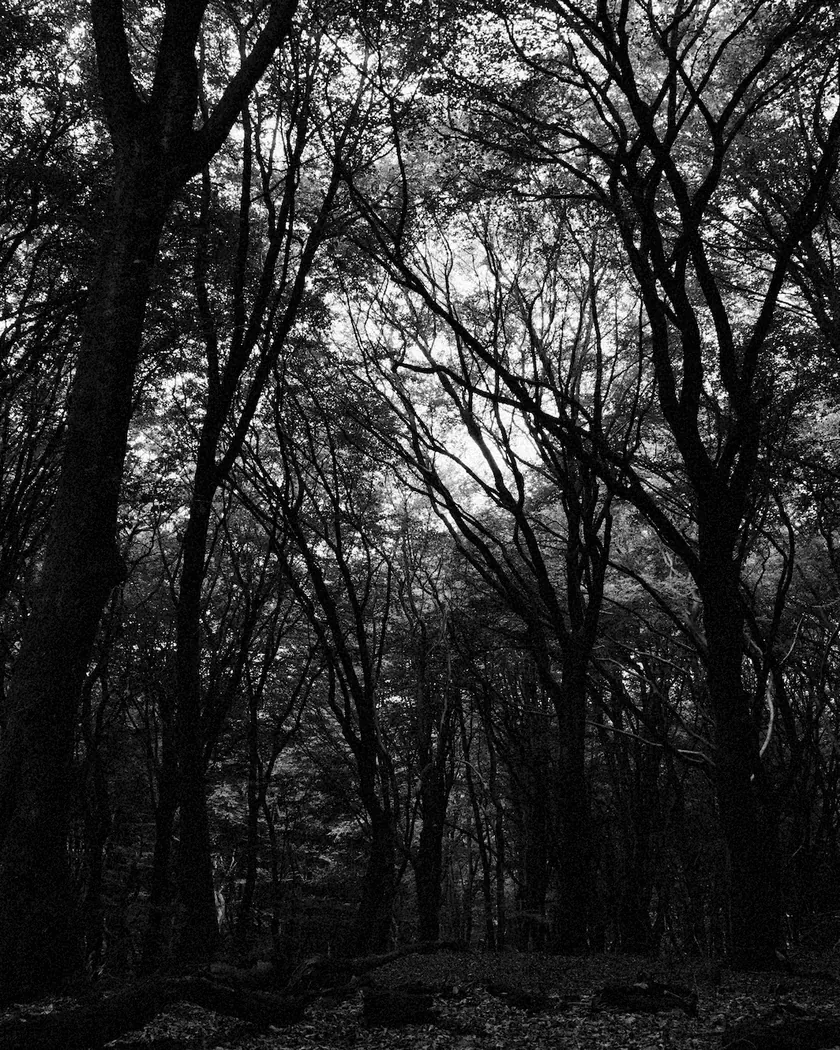
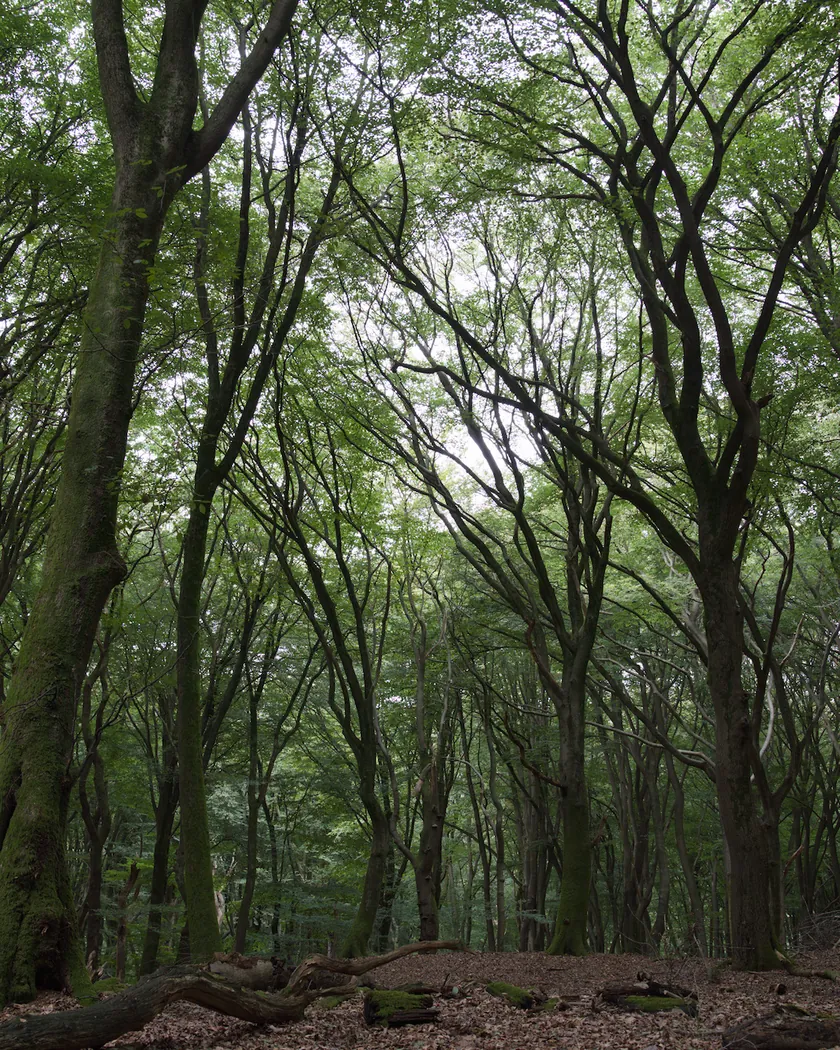
- Blue renders lighter, skin and reds darker. Converting our test RAW files with the Delta 3200 curve instead of plain luminance made a sky 4.4 L* lighter, skin 6.3 L* darker and a pink shirt 3.0 L* darker. That is darker skin than with the Tri-X 400 (−3.8) or HP5 Plus (−5.7) curves [17].
- Extended red. The curve stays high up to about 670 nm, where Tri-X and HP5 Plus have already fallen off [1] [13] [15].
- Filters. Ilford refers to the filter maker’s factors [1].
- Reviews: none of those we read describes how colors translate; they focus on grain, shadows and the low-light look.
Tonality
- Pushed by design. At EI 3200 the film receives about 1⅔ stops less exposure than its ISO speed calls for, and is given extended development [1]. Ilford recommends EI 1600 to 6400 and allows EI 400 to 25000 [1].
- Curve. In Ilfotec DD-X for 9 min (close to the 9½ min given for EI 3200), base plus fog sits high, near 0.3. The toe is short, the straight section rises at about 0.65 over about 1.2 log units, then a progressive shoulder compresses the highlights without blocking them (our reading of the graph) [1].
- Development drives contrast. Ilford’s contrast-time graph gives an average gradient of about 0.56 at 8 min (EI 1600), 0.63 at 9½ min (EI 3200) and 0.74 at 12½ min (EI 6400) in DD-X (our reading) [1].
- The reviews disagree on contrast.
- Blue Moon Camera finds it “low contrast, especially compared to TMax P3200” [6]; Simon King calls it “quite even and grey, even in mixed lighting” [7]; The Darkroom, “medium contrast, very subtle tones” [8].
- Casual Photophile sees “more hard blacks” than HP5 Plus, which it calls “a mosaic of grays” [5].
- Shadows are the point of agreement. At EI 3200, “shadows do have a tendency to underexpose and not hold much detail” [6]; “Delta 3200 definitely does lose that shadow detail” [7]. Underexposed, it turns “really muddy and flat”, so The Darkroom advises metering for the shadows [8]. Julian Tanase finds EI 1600 “much closer to the real sensitivity” [10], and Blue Moon Camera shoots it at 1600 [6].
- Highlights hold. Simon King says it “handles overexposure very nicely”, with “plenty of highlight detail” about four stops over [7]; Analogue Wonderland notes that bright stage lights are not “totally blown out straight away” [9]. That matches the shoulder of the datasheet curve. Our reading: the contrast people see comes mostly from blocked shadows, while midtones and highlights stay moderate.
- Long exposures: no correction from 1/10,000 to ½ s. Beyond that, Ilford’s graph follows adjusted time = metered time^1.33 [1].
Grain and sharpness
| Film | Diffuse RMS granularity | Developer |
|---|---|---|
| Kodak T-Max 400 | 10 [14] | D-76 |
| Kodak Tri-X 400 | 17 [13] | HC-110 (B) |
| Kodak T-Max P3200 | 18 [12] | D-76 |
| Ilford Delta 3200 | not published [1] | – |
| Ilford HP5 Plus | not published [15] | – |
- Harman publishes no granularity or resolving power for Delta 3200 [1]. Ilford’s product page speaks of an “unobtrusive grain structure” [4]. Kodak’s figures are measured at normal development; RMS values from different developers are only roughly comparable.
- Reviews describe grain “in great abundance in highlights, shadows – pretty much everywhere” [5], and “heavy grain in almost all conditions” that stays “oddly smooth, definitely not blocky” [7].
- Format matters: The Darkroom finds the 35 mm grain “chunky” and the 120 grain “more subtle and pleasant looking” [8].
Spectral sensitivity
Ilford’s wedge spectrogram, made under 2856 K tungsten light, is almost flat from 400 to 670 nm, with a shallow dip near 510 nm, and falls steeply only past 670 nm, ending near 698 nm [1]. The 2002 and 2018 editions print the same curve [2] [3], and darktable’s built-in preset treats Delta 400 and Delta 3200 as sharing it [16]. Once the red-rich tungsten light is corrected, blue carries more weight than in any other Grain Archive black-and-white style, so skies render lighter and skin darker than in a luminance conversion [17].
Datasheet digest
| Item | Value | Source |
|---|---|---|
| ISO speed | 1000/31° in daylight (ID-11) | [1] |
| Exposure index | EI 3200 with extended development; good quality from EI 400 to 6400, particularly recommended from 1600 to 6400; up to EI 25000 after tests | [1] |
| Diffuse RMS granularity | Not published | [1] |
| Characteristic curve | Base plus fog about 0.3, short toe, straight section at about 0.65, then a progressive shoulder (Ilfotec DD-X 1+4, 9 min; read from the graph) | [1] |
| Contrast (Ḡ) in DD-X 1+4 | About 0.56 at 8 min (EI 1600), 0.63 at 9½ min (EI 3200), 0.74 at 12½ min (EI 6400); read from the graph | [1] |
| DD-X 1+4, 20 °C, EI 3200 | 9½ min (Microphen stock 9, ID-11 stock 10½) | [1] |
| Reciprocity | No correction from 1/10,000 to ½ s; longer: adjusted time = metered time^1.33 | [1] |
| Handling | Load in subdued light; keep away from airport scanners, carry as hand luggage | [1] |
| Base | 0.125 mm acetate (35 mm and 120) | [2] |
Names, status and history
- 1998. Delta 3200 was introduced in 1998, ten years after Kodak’s T-Max P3200, and replaced Ilford’s HPS film [11] [5].
- Speed rating. The box says 3200, but every edition of the datasheet we read gives an ISO speed of 1000/31° and presents 3200 as an exposure index [1] [3].
- Formats. On September 29, 2026, Ilford’s product page listed the film in 35 mm and 120 [4]. The June 2025 datasheet adds 35 mm × 100 ft bulk rolls [1].
- Datasheet. The current datasheet is dated June 2025. Compared with the November 2018 edition, it adds the bulk rolls and drops the development times for other brands’ developers, such as Kodak D-76 and Rodinal [1] [2].
Alternatives
- Not on file Kodak T-Max P3200
Kodak's direct rival: nominal EI 800 (1000 in T-Max developer), RMS 18 in D-76, and more contrast according to Blue Moon Camera
- GA — 042 Ilford Delta 400 Professional
Same tabular-grain family at ISO 400; darktable's preset treats both films as having the same spectral curve
- GA — 001 Ilford HP5 Plus
Ilford's classic ISO 400, which Ilford rates for high-quality prints up to EI 3200
- GA — 003 Kodak Tri-X 400
Kodak's ISO 400 classic, with published push times to EI 3200 and an RMS of 17 at box speed
Get the look in darktable
The GA — 022 / P preset, inspired by Ilford Delta 3200 Professional, is a darktable 5.6 style of 4 native modules, with no LUT. It sits on top of your own exposure and tone mapping.
| Zone | Metric | Before → after |
|---|---|---|
| sky | L (channel weights only) | 55.2 → 59.6 |
| skin | L (channel weights only) | 79.3 → 73.0 |
| pink T-shirt | L (channel weights only) | 47.8 → 44.8 |
Settings, all measurements and limits of the Ilford Delta 3200 preset
GA — 022 / P · darktable preset
Delta 3200 Professional
for darktable
See real photos
Scans of real Ilford Delta 3200 Professional film, published by others:
- The Darkroom: Ilford Delta 3200 film review and customer photos thedarkroom.com
- Blue Moon Camera: Ilford Delta 3200 film review with sample photos bluemooncameracodex.com
- Casual Photophile: Ilford Delta 3200 film profile, with sample photos casualphotophile.com
Questions about Ilford Delta 3200 Professional
What is the real ISO of Delta 3200?
Ilford gives Delta 3200 an ISO speed of 1000/31°, measured in ID-11 developer. The 3200 on the box is an exposure index: the film is designed to be shot at EI 3200 and given extended development. Some reviewers find EI 1600 closer to its real sensitivity, and Blue Moon Camera shoots it there.
Can you shoot Delta 3200 at 1600?
Yes. Ilford publishes development times for EI 1600, such as 8 minutes in Ilfotec DD-X 1+4 or Microphen stock at 20 °C, and names 1600 to 6400 as the film's preferred range. Reviews say shadows hold more detail than at EI 3200, where they tend to block up.
Can Delta 3200 be pushed to 6400 or 12800?
Yes. Ilford gives times for EI 6400 (12½ minutes in Ilfotec DD-X 1+4) and EI 12500 (17 minutes), and allows EI 25000 after test exposures (25 minutes in DD-X). Contrast rises with development: on Ilford's graph, the average gradient climbs from about 0.63 at 9½ minutes to 0.74 at 12½.
Is Ilford Delta 3200 C-41?
No. Delta 3200 is a traditional black-and-white negative film. Ilford recommends its own black-and-white developers, Ilfotec DD-X, Microphen and ID-11, and gives extended times for push processing. A C-41 color line cannot develop it; it needs a lab or a home setup that processes black-and-white film.
Delta 3200 vs T-Max P3200?
Both are nominally slower than 3200: Ilford rates Delta 3200 at ISO 1000, Kodak rates T-Max P3200 at EI 800, or 1000 in T-Max developer. Kodak publishes an RMS granularity of 18 in D-76; Ilford publishes none. Blue Moon Camera finds Delta 3200 lower in contrast than P3200.
Sources
- 1DS Harman: Delta 3200 Professional Technical Information (June 2025)
- 2DS Harman: Delta 3200 Professional Technical Information (November 2018), Wayback Machine copy
- 3DS Ilford: Delta 3200 Professional fact sheet (September 2002), copy hosted by 125px
- 4M Ilford Photo: Delta 3200 Professional 35mm, product page Accessed September 29, 2026.
- 5C Casual Photophile: Ilford Delta 3200 film profile (Jeb Inge, July 14, 2017) Accessed September 29, 2026.
- 6C Blue Moon Camera: Film Friday, Ilford Delta 3200 film review (Zeb Andrews, October 24, 2025) Accessed September 29, 2026.
- 7C Emulsive: Film Notes, Ilford Delta 3200 and Kodak T-Max P3200 (Simon King and Andrew Blowers, July 11, 2020) Accessed September 29, 2026.
- 8C The Darkroom: Ilford Delta 3200 film review Accessed September 29, 2026.
- 9C Analogue Wonderland: Film review, Ilford Delta 3200 (Emma Lloyd, updated September 21, 2022) Accessed September 29, 2026.
- 10C 35mmc: Ilford Delta 3200, a challenge accepted (Julian Tanase, October 28, 2023) Accessed September 29, 2026.
- 11C Wikipedia: Ilford Delta Accessed September 29, 2026.
- 12DS Kodak Professional T-Max P3200, technical data F-4001 (March 2018)
- 13DS Kodak Professional Tri-X 320 and 400, technical data F-4017 (October 2021)
- 14DS Kodak Professional T-Max 400, technical data F-4043 (February 2016)
- 15DS Harman: HP5 Plus Technical Information (November 2018)
- 16M darktable 5.6.0 source code: color calibration presets (channelmixerrgb.c)
- 17B The Grain Archive: Ilford Delta 3200 style, validation measurements
DS: datasheet · M: manufacturer · C: review or community · B: Grain Archive measurement