KodakT-Max 100
Clean, smooth black and white with very fine grain; more blue-sensitive than T-Max 400
- Manufacturer
- Eastman Kodak
- ISO
- 100
- Type
- Black and white
- Process
- B&W
- Formats
- 135, 120, 4x5, 5x7, 8x10
- Status
- In production
- Datasheet
- F-4016
- Preset
- GA — 047 / P
Character
- Contrast
- Moderate; reviews describe gentle, gradual tonality
- Grain
- Diffuse RMS granularity 8 (datasheet)
- Latitude
- Kodak: forgives overexposure; push to EI 200, 400 or 800
- Best for
- Detailed subjects, big enlargements, copy work (Kodak)
Kodak T-Max 100 is an ISO 100 panchromatic black-and-white negative film with T-Grain crystals, which Kodak markets as the finest-grained 100-speed black-and-white film in the world [1]. Since March 2026, Eastman Kodak also sells a film called Ektapan 100, which the photo press describes as T-Max under a new name; Kodak has not said the two are identical [3] [4] [5]. Kodak Alaris still lists T-Max 100 [2].
Look and color
T-Max 100 turns colors into grays according to its own spectral sensitivity, which leans further toward blue than T-Max 400:
- Blue renders light. Fstoppers writes that T-Max 100 responds strongly to blue and cyan, so skies wash out without a filter, and that orange and yellow filters help while red filters were less flattering [10]. Kodak’s daylight filter factors point the same way: a No. 8 yellow needs ×1.5, against ×1.6 for T-Max 400 and ×2 for Tri-X, so less yellow is needed to lift blues [1] [13] [14].
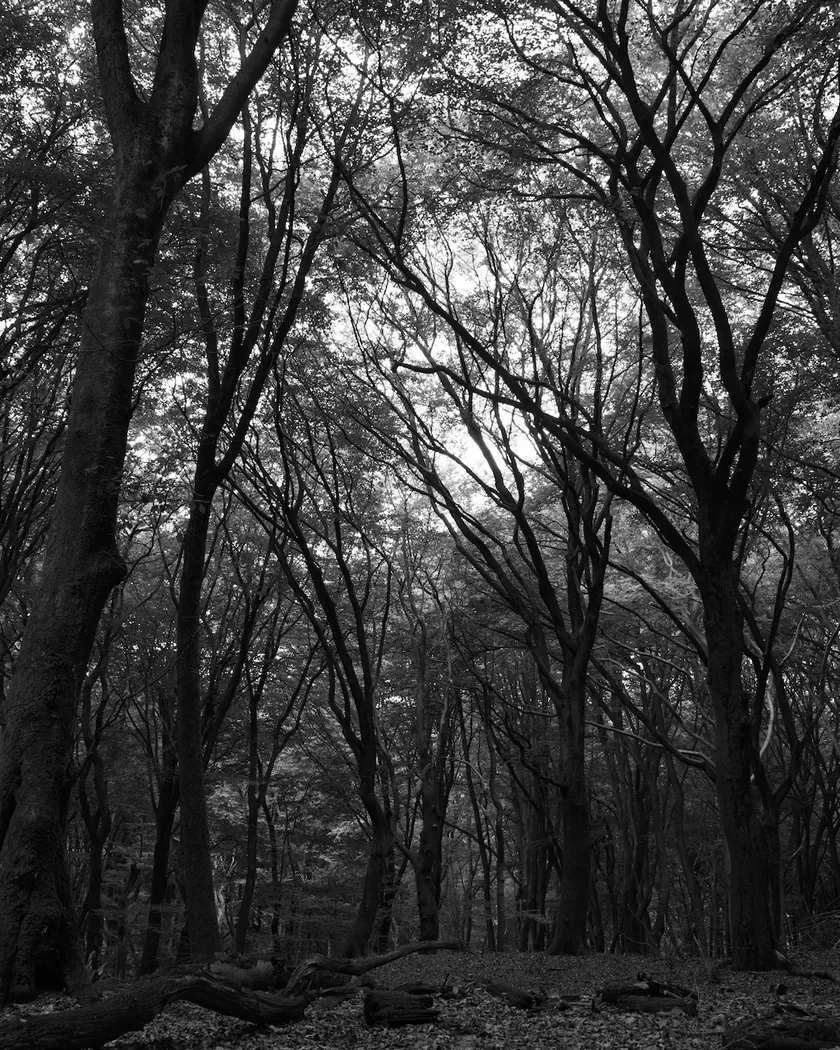
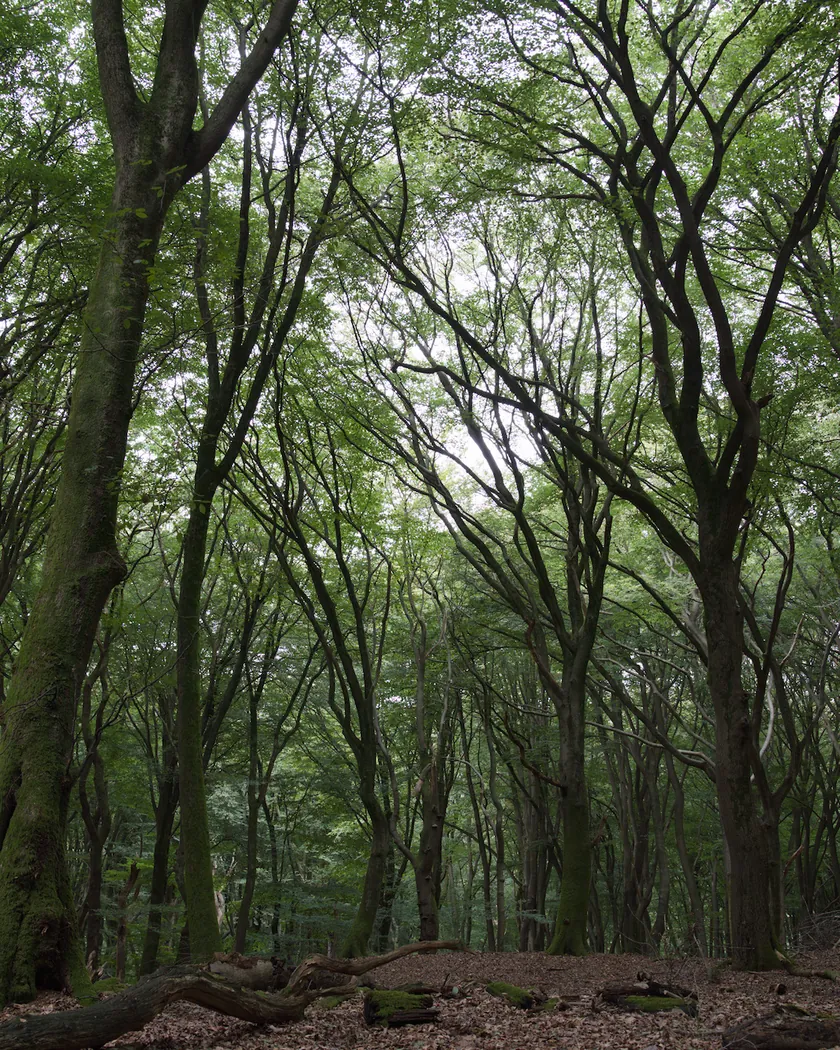
- Skin and reds render darker. Converting our test RAW files with the T-Max 100 curve instead of plain luminance made a sky 4.0 L* lighter, skin 5.4 L* darker and a pink shirt 2.4 L* darker: the same direction as Tri-X, with a larger effect [16].
- Reviews describe “rich tonality” and a “modern contemporary look” rather than a vintage one [7] [8]. Reviewers hardly discuss color rendering; the datasheet curve and one review are the only sources on this point.
Tonality
- Curve. On the datasheet’s D-76 characteristic curves (6, 7.5 and 10 minutes), base plus fog sits near 0.22 density on the 7.5 minute curve. The toe is long and gradual, about 0.8 log unit, the straight section is nearly straight, and there is no visible shoulder on the plotted range (our reading of the graph, roughly ±0.05) [1].
- Development sets the contrast. Kodak advises adding or removing 10 to 15 percent of development time if negatives come out too flat or too contrasty [1].
- Reviews. “The smooth tonality, from the highlights to the shadows can only be described as gentle and gradual” [8]. “TMax shadows are remarkably smooth and even” compared with Tri-X [11]. One tester found the opposite in a three-film test, a “lack of contrast” that looked like “a more gray overcast” than Acros or Delta 100 [12]: reviews disagree, and developer and scene matter.
- Latitude. Kodak cites “good latitude” and greater forgiveness with overexposure [1]:
- for high-contrast scenes, expose one or two stops more and develop normally [1];
- reviewers report that the film tolerates one stop under and two stops over [7], and Blue Moon Camera says it can be shot at EI 200 without adjusting development [11];
- pushing to EI 200, 400 or 800 costs shadow detail and adds grain and contrast; Kodak calls results usually excellent at one and two stops and acceptable at three [1].
- Long exposures: no correction from 1/1,000 to 1/10 s; add ⅓ stop at 1 s, ½ stop at 10 s and 1 stop at 100 s [1].
Grain and sharpness
| Film | Diffuse RMS granularity | Developer |
|---|---|---|
| Fujifilm Neopan 100 Acros II | 7 [15] | Microfine |
| Kodak T-Max 100 | 8 [1] | D-76 |
| Kodak T-Max 400 | 10 [13] | D-76 |
| Kodak Tri-X 400 | 17 [14] | HC-110 (B) |
- RMS values measured in different developers are only roughly comparable.
- Resolving power: 63 lines/mm at a test-object contrast of 1.6:1 and 200 lines/mm at 1000:1, against 50 and 200 for T-Max 400 [1] [13]. Wikipedia notes the film’s resolution is high enough that it is often used to test lens sharpness [6].
- Reviews: “smooth images with little to no grain” [7]; Beau Photo describes the grain as smooth rather than muddy [8]. A reader’s comment reports 16×20 prints from 120 and 8×10 from 35 mm without visible grain [9]. The Shoot It With Film tester described T-Max 100 as “very grainy” [12], which contradicts the datasheet and the other reviews; no developer or scanner is given.
Spectral sensitivity
On an equal-energy basis, sensitivity is highest at the violet end (about 0.50 log at 400 nm), falls to about 0.01 near 500 nm, shows a small bump near 545 nm and a shoulder near 595 nm, then drops gradually to about −0.40 at 640 nm and steeply past 650 nm, where the plotted curve ends near 671 nm [1]. In practice, blue skies turn lighter and skin and reds darker than in a luminance conversion, more than with T-Max 400 [16].
Datasheet digest
| Item | Value | Source |
|---|---|---|
| ISO speed | 100/21° in most developers | [1] |
| Diffuse RMS granularity | 8 (D-76, 20 °C; net density 1.00, 48 µm aperture, 12×) | [1] |
| Resolving power | 63 lines/mm at 1.6:1, 200 lines/mm at 1000:1 | [1] |
| Characteristic curve | Long, gradual toe, nearly straight section, no shoulder on the plotted range (read from the 7.5 min graph) | [1] |
| Contrast adjustment | Increase or decrease development time by 10 to 15 % if negatives are too flat or too contrasty | [1] |
| Push processing | Development times published for EI 200 (1 stop), EI 400 (2 stops) and EI 800 (3 stops) | [1] |
| Reciprocity | No correction from 1/1,000 to 1/10 s; +⅓ stop at 1 s, +½ stop at 10 s, +1 stop at 100 s | [1] |
| D-76 stock, small tank, 20 °C | 6½ min (6¼ min in a rotary tube) | [1] |
| T-Max developer 1:4, small tank, 20 °C | 7½ min | [1] |
| Filter factors, daylight | No. 8 yellow ×1.5, No. 15 deep yellow ×2, No. 25 red ×8, No. 47 blue ×8, No. 58 green ×6 | [1] |
Names, status and history
- 1986. Kodak has made the T-Max range since 1986; edge marking TMX identifies the ISO 100 film [6].
- Kodak Alaris. For years, Kodak Alaris distributed T-Max, and it publishes the current datasheet, F-4016, revised June 2018 [1] [4]. On September 30, 2026, it listed T-Max 100 in 135-24, 135-36, 120, sheets in 4×5, 5×7 and 8×10, and 35 mm bulk, with no discontinuation notice [2].
- Ektapan 100 (March 2026). On March 24, 2026, Eastman Kodak launched Ektapan 100, 400 and P3200, matching the T-Max speeds [5].
- PetaPixel: the new Ektapan “bears more than a passing resemblance” to T-Max, at the same price at B&H [4]. Kosmo Foto calls them “new branding” for the T-Max series [5].
- Kodak’s Ektapan 100 page lists 135-36, 35 mm bulk, 120 and 4×5, describes “high sharpness, fine grain, and impressive resolving power”, mentions no T-Max and links no datasheet [3].
- We found no Kodak statement that the emulsions are identical. Treat the rename as reported, not confirmed; the T-Max 100 datasheet is the only one we found for this film.
Alternatives
- GA — 019 Kodak T-Max 400
Same T-Grain family at ISO 400: RMS 10 against 8, and a flatter response across 400 to 600 nm
- GA — 023 Fujifilm Neopan 100 Acros II
Fujifilm's ISO 100 black and white: RMS 7, though measured in Microfine, not D-76
- GA — 020 Ilford FP4 Plus
Ilford's ISO 125 all-rounder; Ilford publishes no RMS figure for the still film, so grain cannot be compared on paper
- GA — 024 Fomapan 100 Classic
Another ISO 100 black-and-white film, with RMS 13.5 in Microphen, coarser on paper than T-Max 100's 8
- GA — 003 Kodak Tri-X 400
Kodak's cubic-grain classic: RMS 17, much more visible grain and bolder contrast
Get the look in darktable
The GA — 047 / P preset, inspired by Kodak T-Max 100, is a darktable 5.6 style of 4 native modules, with no LUT. It sits on top of your own exposure and tone mapping.
| Zone | Metric | Before → after |
|---|---|---|
| sky | L (channel weights only) | 55.2 → 59.2 |
| sea | L (channel weights only) | 37.9 → 40.4 |
| skin | L (channel weights only) | 79.3 → 73.9 |
Settings, all measurements and limits of the Kodak T-Max 100 preset
GA — 047 / P · darktable preset
T-Max 100
for darktable
See real photos
Scans of real Kodak T-Max 100 film, published by others:
- Casual Photophile: Kodak Professional T-Max 100 film profile, with sample photos casualphotophile.com
- Mr Leica: Kodak T-Max 100 review, sample photos in Xtol and Rodinal mrleica.com
- Blue Moon Camera: Film Friday, Kodak T-Max 100, with sample photos bluemooncameracodex.com
Questions about Kodak T-Max 100
Is Ektapan 100 the same as T-Max 100?
Reportedly, yes. Eastman Kodak launched Ektapan 100, 400 and P3200 in March 2026 at the same speeds as T-Max, and the press calls them new branding for T-Max. Kodak's Ektapan 100 page never mentions T-Max and links no datasheet, so treat the rename as reported, not confirmed. [3] [4] [5]
Is Kodak T-Max 100 still made?
Yes. On September 30, 2026, Kodak Alaris still listed T-Max 100 in 135 (24 and 36 exposures), 120, sheets from 4×5 to 8×10 and 35 mm bulk, with no discontinuation notice. Eastman Kodak separately sells Ektapan 100, which the press describes as a rebrand of the same film. [2] [3] [4]
Can you push T-Max 100 to 400?
Yes. Kodak publishes development times for EI 200, 400 and 800 in T-Max, XTOL, D-76 and HC-110, and calls results usually excellent at one and two stops and acceptable at three. Expect more contrast and grain and less shadow detail; Kodak says T-Max developers give better shadow detail when pushing. [1]
Why did my T-Max negatives come out pink?
A magenta stain after fixing is a known T-Max trait. Kodak says the film exhausts fixer faster than other films and that the stain means the fixer is near exhaustion or the time was too short. A slight stain does not affect stability; a heavy, uneven one calls for refixing in fresh fixer. [1] [10]
T-Max 100 or Acros II?
On paper, Acros II is slightly finer: Fujifilm lists RMS 7 in Microfine, Kodak 8 in D-76, so the developers differ. Reviewers disagree on look: one tester found T-Max flatter and Acros more contrasty; another rates T-Max shadows as smooth and even. The two datasheets do not settle contrast. [1] [12] [11] [15]
Sources
- 1DS Kodak Professional T-Max 100, technical data F-4016 (June 2018)
- 2M Kodak Alaris: Kodak Professional T-Max 100 film, product page Accessed September 30, 2026.
- 3M Eastman Kodak: Ektapan 100 film, product page Accessed September 30, 2026.
- 4C PetaPixel: Kodak revives the Ektapan name for three 'new' black and white films (Jeremy Gray, March 24, 2026) Accessed September 30, 2026.
- 5C Kosmo Foto: Eastman Kodak reveals new Ektacolor Pro and Ektapan film ranges (Stephen Dowling, March 24, 2026) Accessed September 30, 2026.
- 6C Wikipedia: Kodak T-MAX Accessed September 30, 2026.
- 7C Casual Photophile: Kodak Professional T-Max 100 film profile (James Tocchio, February 8, 2019) Accessed September 30, 2026.
- 8C Beau Photo: Film Friday #17, Kodak T-Max 100 (Kathy K, November 19, 2020) Accessed September 30, 2026.
- 9C Mr Leica: Kodak T-Max 100 review, sample photos in Xtol and Rodinal (Matt Osborne, undated) Accessed September 30, 2026.
- 10C Fstoppers: Kodak T-Max 100, 10 tips to give you the best results (David Hancock, January 31, 2022) Accessed September 30, 2026.
- 11C Blue Moon Camera: Film Friday, Kodak T-Max 100 (Zeb Andrews, August 21, 2026) Accessed September 30, 2026.
- 12C Shoot It With Film: Kodak T-Max vs Ilford Delta vs Fuji Acros (Temi Lawson, June 3, 2022) Accessed September 30, 2026.
- 13DS Kodak Professional T-Max 400, technical data F-4043 (February 2016)
- 14DS Kodak Professional Tri-X 320 and 400, technical data F-4017 (October 2021)
- 15DS Fujifilm: Neopan 100 Acros II (135), data sheet AF3-0258E (February 2020)
- 16B The Grain Archive: Kodak T-Max 100 style, validation measurements
DS: datasheet · M: manufacturer · C: review or community · B: Grain Archive measurement